News

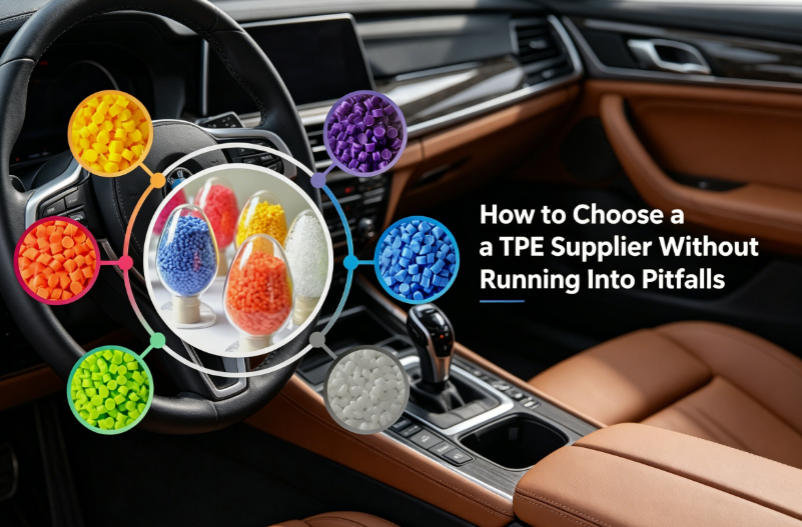
​How to choose a TPE plastic supplier without running Into pitfalls?

2026-07-01 0 Leave me a message

Procuring thermoplastic elastomers (TPE) is becoming increasingly complex. Demand continues to grow in the automotive, medical, and consumer electronics sectors, and there are more and more suppliers claiming to be “TPE plastic factories.” However, when you request a custom formulation or batch consistency, many of these promises quickly fall through.

When evaluating TPE plastic partners, the following four criteria can help distinguish reliable sources from supply chain risks:

1. Formulation expertise, which indicates what they are truly capable of.

TPE plastic is not a single material. A grade that bonds well with PC may not necessarily bond with PA or ABS. A true compounding facility possesses a substantial formulation database and an R&D team capable of adjusting hardness, adhesion, compression set, or transparency based on fundamental principles. Take Suzhou Zhongsu Wang as an example: the facility has been engaged in compounding since 2003 and has consistently regarded customization as a core competency. When a customer requires ultra-high transparency or food-contact compliance, the response isn’t “Let’s check our existing grades,” but rather a tailored formulation proposal. This level of expertise is worth evaluating before entering into a partnership.

2. Production scale is a commitment to delivery capability.

A single production line can produce prototypes, but it cannot guarantee uninterrupted production during peak seasons. It is essential to consider multi-site production capacity. Huizhou Zhongsu Wang operates 20 production lines across four industrial bases, with an annual production capacity of approximately 30,000 metric tons. This setup offers two advantages: it shortens the logistics radius for manufacturing clusters in South and East China, while providing a buffer during demand fluctuations. If a supplier cannot demonstrate how they handle rush orders, you can assume they are unable to do so.

3. Quality control should be meticulous and thorough.

Batch-to-batch variations in TPE plastic can silently erode your yield rate. A reliable compounding plant inspects incoming raw materials, monitors the process at the twin-screw extruder, and performs final inspections on each batch of finished products for metrics such as melt flow index, hardness, tensile strength, and specific gravity. Certifications such as RoHS, REACH, FDA, and LFGB should be issued in the factory’s own name, not under a borrowed one. This is not merely paperwork; it ensures consistency so that process parameters do not need to be adjusted with every shipment.

4. Technical support should go beyond the transaction itself.

The true test of a supplier comes when molding issues arise, such as surface defects, poor overmolding adhesion, or abnormal shrinkage. A true partner will dispatch an application engineer to stand by the injection molding machine and work with you to resolve the issue.

In summary, selecting a TPE plastic manufacturer is not about finding the lowest price per kilogram, but rather assessing whether the supplier’s R&D, production capacity, quality control, and service capabilities can ensure product consistency and supply chain predictability. When these four pillars are firmly established, the time spent resolving material issues will be significantly reduced, allowing you to focus more energy on part production.


Related News
Leave me a message
在线客服系统
X
We use cookies to offer you a better browsing experience, analyze site traffic and personalize content. By using this site, you agree to our use of cookies.Privacy Policy
RejectAccept