News

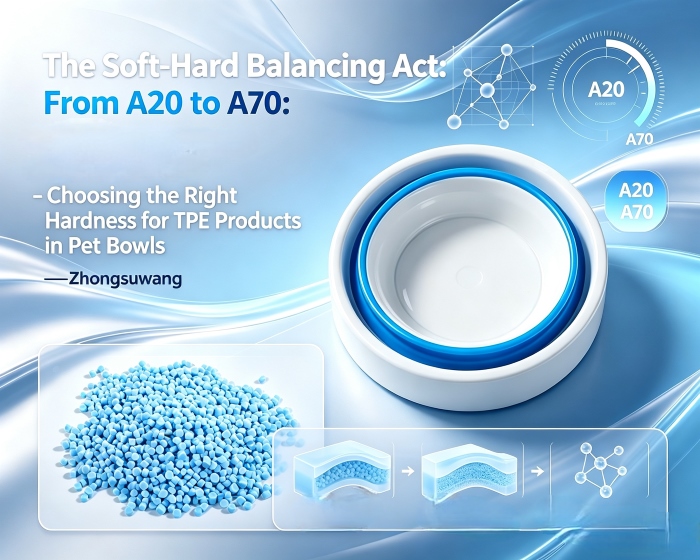
The Soft-Hard Balancing Act: From A20 to A70 – Choosing the Right Hardness for TPE Products in Pet Bowls

2026-08-18 0 Leave me a message

When pets push against the bowl or step on the non-slip mat while eating, the force applied varies significantly from one pet to another. If the material is too soft, the non-slip components can easily be compressed or displaced. If it is too hard, however, the soft, rubberized texture and the anti-slip function are compromised. Selecting the right hardness for TPE products in pet bowls essentially involves striking a balance between anti-slip performance, structural support, and durability.


I. Hardness Ranges Based on Application Location

TPE products in different parts of a pet bowl have distinctly different hardness requirements. The anti-slip ring or pad on the bottom is the most common application area for these parts. This section needs to be sufficiently soft to conform to the surface and provide stable traction. For this part, a hardness between Shore A20 and A40 is typically selected, ensuring anti-slip effectiveness without frequent deformation due to excessive softness.


If the bowl itself is a TPE product, the hardness needs to be correspondingly higher, generally falling between Shore A50 and A70. This range allows the bowl to maintain its shape when filled with water and food, while retaining a certain degree of elasticity and impact resistance. For large-sized or heavy-duty pet bowls, the hardness can be further increased to A70 or higher. However, the Shore D scale is considered too hard for pet bowls, as it feels similar to rigid plastic and is rarely used in everyday pet products.


II. Differentiated Needs for Different Pets and Scenarios

Dogs exert significant pushing force while eating, so the hardness of the non-slip pads on the bottom of dog bowls can be slightly higher. A Shore A30 to A40 range is a safe choice. Non-slip pads for cat bowls and puppy bowls can be softer. An A20 to A30 range offers a better feel while still providing sufficient slip resistance. For slow-feeding bowls, the non-slip pads need to withstand sustained pushing force, making an A35 to A50 range more suitable. For portable outdoor water bowls with TPE-coated bottoms, a balance between ground adaptability and durability is essential. Shore A30 to A45 offers a good compromise. When selecting TPE products for these different scenarios, it is important to match the hardness to the expected forces and environment.


III. Impact of Hardness on Actual Use

At lower hardness levels, Shore A20 and below, TPE has a slower rebound rate, and the non-slip pads are prone to permanent deformation after repeated trampling. Conversely, materials with a Shore A hardness of 80 or higher offer better wear resistance and bite resistance but feel more like hard plastic, resulting in a significant decrease in anti-slip effectiveness. TPE products for pet bowls typically do not require the high hardness of the Shore D scale. This range is more commonly used for structural components requiring high rigidity, which does not fully align with the pet bowl's emphasis on anti-slip performance and a soft tactile feel.


Based on the hardness scale, Shore A20 to A40 is suitable for bottom anti-slip components, while A50 to A70 is suitable for bowl bodies or support structures that need to retain their shape. Shore A80 and above, as well as Shore D-grade materials, are rarely used in pet bowls. 20C and 0A fall within the ultra-soft range and are suitable for accessories such as protective pads, but they lack sufficient strength to serve as the primary material for the bowl body. Hardness levels from 5A to 10A are also on the softer side and are better suited for thin-layer overmolding or cushioning strips.


IV. Material Selection and Validation Approach

When selecting materials, brand owners can first categorize components based on two functional types, load-bearing structures and anti-slip contact points, and then determine the appropriate hardness ranges for each. After prototyping, simulate actual usage conditions by filling the TPE products with water and food to observe deformation. Press the anti-slip components by hand to check their rebound and recovery performance. These tests provide a more accurate representation of real-world usage than relying solely on hardness values.


Zhongsu Wang TPE offers mature formulation solutions for pet products, with hardness ranging from Shore A5 to A90. These formulations can be tailored to the specific structural and functional requirements of pet bowls, helping brands strike the right balance between slip resistance, durability, and tactile feel.


Related News
Leave me a message
在线客服系统
X
We use cookies to offer you a better browsing experience, analyze site traffic and personalize content. By using this site, you agree to our use of cookies.Privacy Policy