News

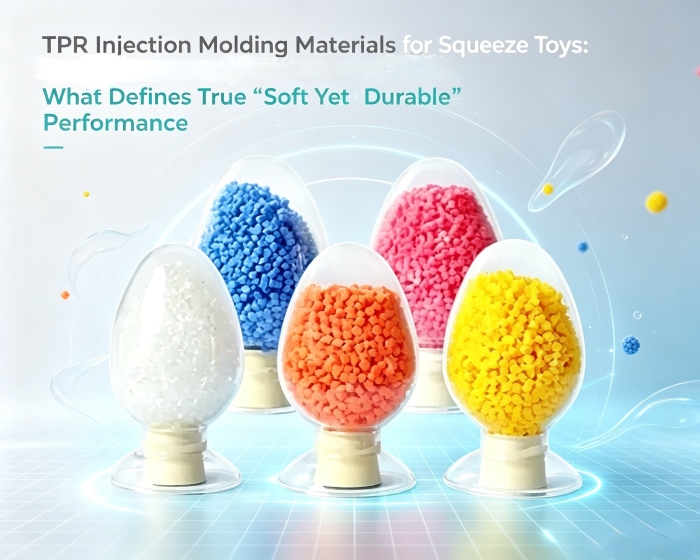
TPR Injection Molding Materials for Squeeze Toys: What Defines True “Soft Yet Durable” Performance

2026-08-08 0 Leave me a message

When selecting materials for stress-relief toys, brands are increasingly shifting their focus from “how soft the material can be” to “how long it can maintain its softness.” The soft, supple feel provided by low hardness is fundamental to the user experience in this category. However, if the material tears during repeated squeezing, both the product’s lifespan and user satisfaction will be directly affected. For TPR injection molding materials, being soft without breaking is not merely a parameter on a physical properties table. It is a crucial indicator of formulation maturity. Achieving this requires a comprehensive integration of base material selection, white oil systems, filler combinations, and processing techniques. If any one of these elements is missing, it becomes difficult to maintain consistent toughness at low hardness levels.


Let’s start with the base material. The rubber phase in TPR injection molding materials is typically dominated by SEBS. The higher the molecular weight, the more fully entangled the molecular chains become, resulting in better tensile strength and elongation at break. Selecting high-molecular-weight SEBS as the backbone is fundamental to ensuring toughness. Some formulations also incorporate other elastomer components through blending, leveraging synergistic effects to maintain sufficient tear resistance at low hardness levels. Once the framework is established, the next step is adjusting the hardness, which involves selecting the right white oil.


Ultra-soft TPR injection molding materials require a larger amount of white oil to reduce hardness, but white oil also dilutes the entanglement between molecular chains, thereby weakening strength. The balance between softness and tear resistance lies in the quality of the white oil and precise control of its dosage. Deeply hydrogenated white oil exhibits better compatibility with SEBS and disperses uniformly within the matrix, producing a relatively mild impact on mechanical properties. Its dosage must be precisely calibrated to fall within the balance range between hardness and strength. If the white oil system is properly controlled, toughness can be maintained within an acceptable range. However, if further reinforcement is needed, introducing a third component into the formulation must be considered.


This is where fillers play a critical role. A small amount of nanoscale reinforcing filler can enhance tear resistance through physical cross-linking without significantly increasing hardness. The filler dosage and dispersion process must be strictly controlled. Excessive amounts will harden the material, defeating the original goal of ultra-softness, while uneven dispersion will create stress concentration points within the material, serving as initiation points for fracture. When the skeleton, white oil, and filler are properly balanced, the foundation for toughness in the formulation is largely established.


However, no matter how well the formulation is designed, the toughness of the finished product may still be compromised if problems arise during the processing stage. If TPR injection molding materials are not sufficiently plastified during molding or if the cooling rate is improperly controlled, residual internal stresses will remain within the part. These stresses are gradually released through repeated squeezing, manifesting as cracks that appear after a period of use. Therefore, achieving a material that is soft yet resistant to breakage depends not only on formulation design but also on the proper coordination of the temperature profile, holding pressure time, and cooling rate during the injection molding process to fully unlock the formulation’s toughness potential.


When screening TPR injection molding materials, brand manufacturers can preliminarily assess a material’s toughness level through tensile fatigue testing and repeated squeezing tests. Stretch a sample strip to a certain multiple of its original length and release it. Repeat this process multiple times to observe whether microcracks form. Simultaneously, squeeze the finished product hundreds of times by hand to determine if there is a noticeable decline in strength. These test conditions can effectively identify formulations that meet hardness requirements but lack sufficient toughness.


About Us:

Zhongsu Wang TPE has accumulated extensive formulation expertise in TPR materials for stress-relief toys. Our R&D team consists of five senior engineers with over ten years of experience, supported by 18 twin-screw extrusion and pelletizing production lines from renowned brands, with an annual production capacity of 15,000 metric tons, enabling us to balance formulation development with stable, large-scale production. In terms of quality control, our testing center is equipped with professional equipment such as RoHS analyzers, QUV testers, and melt flow index testers to systematically verify every batch of material. Our products serve the automotive, consumer electronics, toy, and medical sectors and are exported to more than 20 countries, including Mexico, Indonesia, and Vietnam, helping brand owners achieve a reliable balance between hardness, toughness, and tactile feel.


Related News
Leave me a message
在线客服系统
X
We use cookies to offer you a better browsing experience, analyze site traffic and personalize content. By using this site, you agree to our use of cookies.Privacy Policy
RejectAccept